
Buying too much paint wastes money. Buying too little delays your project and risks colour matching issues. Getting the quantity right matters.

Here's how to accurately calculate Resene paint requirements for your Wellington project.
Quick Reference: Resene Coverage Rates
Standard Coverage (per litre)
Interior walls (SpaceCote Low Sheen):
- New plasterboard: 14–16m²
- Previously painted smooth walls: 12–14m²
- Textured surfaces: 9–11m²
Ceilings (SpaceCote Flat):
- Smooth ceiling: 14–16m²
- Textured ceiling: 10–12m²
Exterior (Lumbersider):
- Smooth weatherboards: 10–12m²
- Rough weatherboards: 8–10m²
- New timber: 6–8m² (absorbs more)
Exterior masonry (Sonyx 101):
- Smooth concrete: 10–12m²
- Textured masonry: 7–9m²
- Brick: 6–8m²
Trim and doors (Lustacryl/Enamacryl):
- 10–12m² per litre
Coverage rates are quoted by Resene for ideal conditions: good surfaces, experienced applicator, roller application. Real-world conditions often reduce these figures by 10–20%. We'll explain the adjustments below.
The Basic Formula
Paint required (litres) = Total surface area (m²) ÷ Coverage rate × Number of coats
Most Resene applications require 2 coats for optimal finish and durability. Skipping a coat to save paint is a false economy — you'll see the result within months as the finish starts to look thin and patchy, particularly where wall surfaces catch raking light.
Step-by-Step Room Calculator
Step 1: Measure Your Room
Walls:
- Measure room perimeter: (Length + Width) × 2
- Measure wall height floor to ceiling
- Calculate: Perimeter × Height = Wall area
Example: 4m × 3m room with 2.4m ceiling
- Perimeter: (4 + 3) × 2 = 14m
- Wall area: 14m × 2.4m = 33.6m²
Ceiling:
- Simply: Length × Width
Example: 4m × 3m = 12m²
For Wellington homes with non-rectangular rooms — bay windows, alcoves, chimney breasts — measure each wall segment individually and add them up. It takes a few extra minutes but prevents the frustrating mid-project paint shortage.
Step 2: Deduct Openings
Subtract windows and doors for accuracy:
Standard deductions:
- Standard door: 2m²
- Window: 1.5m²
- Large window/ranch slider: 3m²
Example room calculation:
- Wall area: 33.6m²
- Minus 1 door (2m²)
- Minus 2 windows (3m²)
- Net wall area: 28.6m²
Many DIYers skip this step and simply round up instead. That works fine for rooms with minimal openings, but a room with three large windows and two doors — common in Wellington villas with their generous fenestration — might have 10–15m² of openings, which can represent a litre or two of unnecessary paint.
Step 3: Calculate Paint Quantity
Walls (2 coats, SpaceCote Low Sheen):
- 28.6m² ÷ 13m² coverage × 2 coats = 4.4 litres
- Purchase: 4L + 2L = 6L total
Ceiling (2 coats, SpaceCote Flat):
- 12m² ÷ 15m² coverage × 2 coats = 1.6 litres
- Purchase: 2L
Total for room: 8L
Common Room Sizes (Wellington Homes)
Small Bedroom (3m × 3m, 2.4m ceiling)
- Walls: ~4L
- Ceiling: ~2L
- Total: 6L
Standard Living Room (5m × 4m, 2.4m ceiling)
- Walls: ~8L
- Ceiling: ~2L
- Total: 10L
Open-plan Kitchen/Dining/Living (8m × 5m, 2.7m ceiling)
- Walls: ~16L
- Ceiling: ~4L
- Total: 20L
Whole 3-Bedroom Villa Interior
Typical Wellington villa (100–120m² floor):
- All walls: ~35–40L
- All ceilings: ~10–12L
- Trims/doors: ~8–10L
- Total: 55–65L
Wellington's villa stock — particularly in Thorndon, Newtown, and Kilbirnie — tends to have higher stud heights (2.7m–3.0m in older homes vs the modern 2.4m standard) and more ornate trim work: picture rails, skirting, casings, and architraves that add up. Budget an extra 10–15% on trim paint for traditional villas.
Exterior Calculations
Weatherboard House
Measurements needed:
- Wall height (ground to gutter)
- House perimeter
- Gable areas (height × width ÷ 2 for each gable)
Example: Single-storey villa
- Perimeter: 40m
- Wall height: 3m
- Wall area: 120m²
- Two gables: 8m² each = 16m²
- Total: 136m²
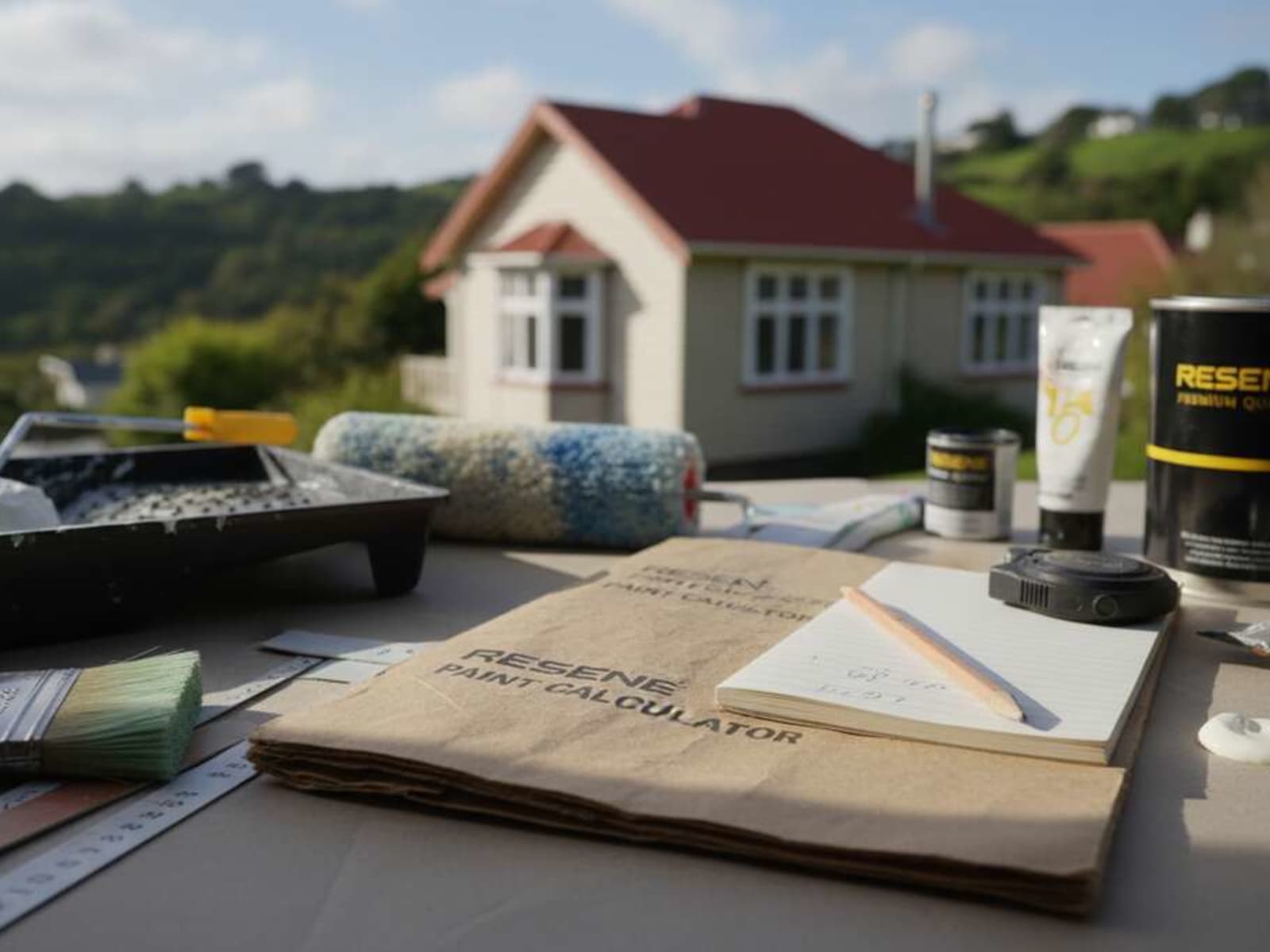
Paint required (Lumbersider, 2 coats):
- 136m² ÷ 11m² coverage × 2 coats = 24.7L
- Purchase: 25L (2×10L + 1×5L)
Plus trim:
- Measure all fascia, barge boards, window frames
- Typical villa: ~20–25L trim paint (Lustacryl)
Wellington's wind-driven rain means exterior surfaces work harder than in most other New Zealand cities. We typically recommend a primer coat on bare or heavily weathered timber before the two topcoats — factor this into your calculation as it adds roughly 50–60% to total paint volume for a bare timber project.
Masonry/Concrete
Porous surfaces need more paint:
Example: 100m² concrete block wall
- First coat absorption: 100m² ÷ 8m² = 12.5L
- Second coat: 100m² ÷ 10m² = 10L
- Total: 23L
Bare concrete is notoriously thirsty. An unsealed block wall can absorb two to three times the paint of a previously painted surface. If you're painting bare concrete for the first time, budget generously — underestimating here means a trip back to the shop mid-project when the colour coverage is clearly insufficient after one coat.
Resene Product-Specific Coverage
Interior Products
SpaceCote Low Sheen: 13–14m²/L
SpaceCote Flat: 14–15m²/L
Zylone Sheen: 13–14m²/L
Ceiling Paint: 14–16m²/L
Kitchen & Bathroom: 12–13m²/L
Exterior Products
Lumbersider: 10–11m²/L
Sonyx 101: 9–10m²/L
Hi-Glo: 11–12m²/L
X-200 (waterproofing): 6–8m²/L
Primers
Broadwall Surface Prep: 10–12m²/L
Quick Dry Primer: 12–14m²/L
Sureseal: 8–10m²/L
Factors That Reduce Coverage
Surface Porosity
- New plasterboard/timber: 20–30% more paint needed
- Unsealed masonry: 40–50% more paint needed
- Previously painted: Standard coverage applies
Surface Texture
- Smooth: Standard coverage
- Light texture: 15–20% more paint
- Heavy texture: 30–40% more paint
Colour Changes
- Light over dark: May need 3 coats (50% more paint)
- Dark over light: Usually 2 coats sufficient
- Dramatic changes: Consider tinted primer
A tinted primer — matched to approximately halfway between your current colour and target colour — can dramatically reduce the coats needed for a dramatic colour change. For a wall going from deep charcoal to a pale cream, a tinted mid-grey primer followed by two topcoats will achieve a better result than three topcoats over the dark colour.
Application Method
- Roller: Standard coverage rates
- Brush: 10–15% more paint (more absorbed, less efficient)
- Spray: 20–30% more paint (overspray, absorption)
Money-Saving Tips
Buy Larger Containers
Resene pricing per litre:
- 1L: ~$20/L
- 4L: ~$18/L
- 10L: ~$16/L
Example: 25L needed
- Buying 25×1L: ~$500
- Buying 2×10L + 1×4L + 1×1L: ~$400
- Saving: $100
The difference sounds small, but on a whole-house project requiring 60L of wall paint, the same logic delivers savings of $150–200 — enough to cover a quality roller set and a few extra brushes.
Round Up, Not Down
Paint is expensive to match later. If calculation shows 8.3L needed, buy 10L not 8L. Leftover paint stores well (5+ years sealed) for touch-ups.
This is particularly important for custom colours. Resene tints to your specification at point of sale — if you run out and need more six months later, the machine and your tinting formula should produce a close match, but there's always slight batch variation. Having 10–20% leftover eliminates this risk entirely.
Consider Whole-House Approach
Using same colour multiple rooms? Buy in bulk:
- Different colours every room: Buy exact amounts
- Same neutral throughout: One large order = better pricing
Using Resene's Online Calculator
Resene provides a free online calculator at resene.co.nz:
Advantages:
- Quick estimates
- Product-specific coverage rates
- Accounts for coats needed
Limitations:
- Doesn't account for surface condition
- Assumes standard texture
- Can't assess colour change requirements
Our recommendation: Use Resene calculator as starting point, then adjust for your specific conditions using the factors above.
When to Add Extra Paint
Add 10–20% if:
- Surface very porous (new timber, unsealed masonry)
- Heavy texture
- Significant colour change
- Inexperienced painter (more waste)
Add 20–30% if:
- Spray application
- Extremely rough surface
- First time painting (learning curve)
Common Mistakes to Avoid
Underestimating Trim
Doors, windows, skirting boards add up quickly. Measure separately. In a Wellington villa with 8 doors, 12 windows, and ornate skirting boards throughout, trim paint can represent 30–40% of total paint cost. Don't treat it as an afterthought.

Forgetting Primer
New surfaces often need primer, which isn't included in standard calculations. Budget for it separately — primer is not interchangeable with topcoat, and skipping it on new plasterboard or bare timber will show in the finished result.
Ignoring Surface Condition
Calculations assume good surface condition. Damaged, flaky, or very porous surfaces need significantly more paint. A surface inspection before buying paint is always worthwhile — ideally in good light, with your hand run over the surface to check for chalking, flaking, or unusual texture.
Not Testing Coverage
Buy a testpot (60ml), paint 1m² properly, see actual coverage achieved on your surface before ordering bulk. This is especially important for Resene's more saturated colours — deep blacks, navies, and forest greens sometimes need an extra coat compared to lighter shades, and discovering this on a testpot is far cheaper than on the fourth litre of a $180 can.
Buying Multiple Small Tins of the Same Colour
If you need 8L of one colour, buy a 10L pail rather than two 4L tins. Beyond the cost saving, mixing multiple tins of the same colour batch ensures consistent tinting across the whole job. Different production batches can have slight colour variation — invisible individually, but potentially noticeable side-by-side on a large wall.
Professional Estimation
We provide free, accurate paint quantity estimates including:
- Site measurement and surface assessment
- Product recommendation for specific surfaces
- Primer requirements
- Contingency for unexpected issues
This eliminates guesswork and ensures you have correct quantities before project starts. When we quote a job, we measure every surface, assess its condition, and specify the exact product and quantity for each area. There are no surprises mid-project, no emergency colour-matching runs to the ColorShop, and no under-specified surfaces that look thin a year later.
Related Services:
- Interior House Painting — Professional interior painting with accurate estimates
- Exterior House Painting — Complete exterior coating solutions
- Free Quote — Get accurate paint quantities and project estimate
Need help calculating paint requirements? Contact us for a free site visit and detailed quantity estimate. We'll ensure you have exactly what you need.
Professional Colour Consultation in Your Area
Need help choosing the right colours? We offer free colour consultations across Wellington: Paint Colour Visualiser · Paint Cost Calculator · Exterior Painting · Interior Painting. Get a free quote today.
Related Articles


Need Help With Your Painting Project?
Wellington Decorators has been transforming homes across the Wellington region since 2023, led by a founder with 18+ years in the trade. As Registered Master Painters, we back every job with a 5-year workmanship guarantee.