
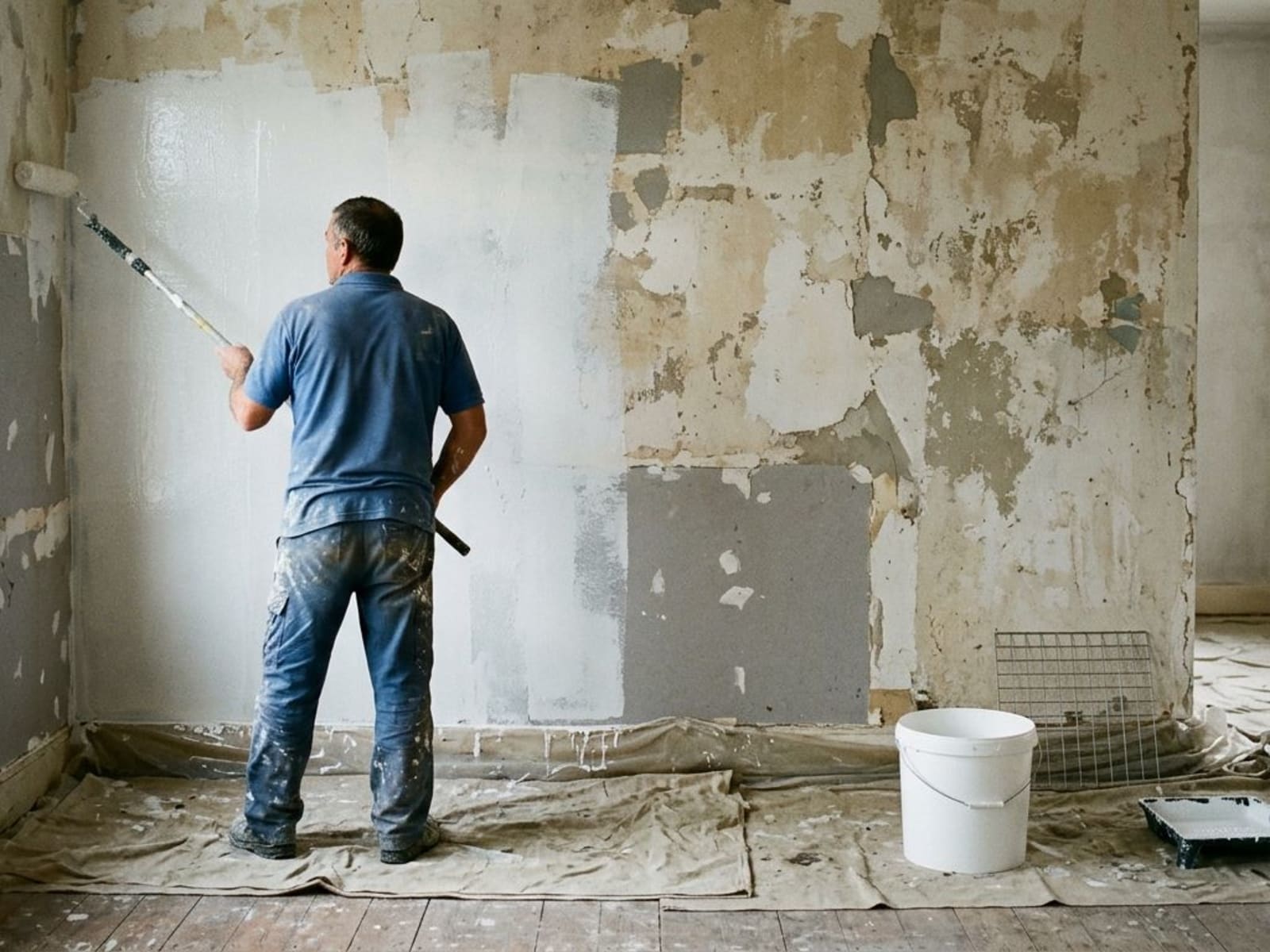
You have to get the adhesive off, not paint over it. Wallpaper paste stays water-soluble for years, so waterborne paint rolled straight onto a wall with residue on it re-wets the glue underneath, and the result is a surface that stays tacky, crazes, or lifts away in sheets a few weeks later.
The order is washing, rinsing, drying, sealing, then painting. Skipping the rinse is the most common reason a stripped wall goes wrong, and skipping the seal is the second.
How do you know there is still glue on the wall?
Wet a patch of the stripped wall with warm water and rub it with your fingertips after a minute. Adhesive residue goes slippery and faintly slimy. Clean plaster or board does not.
Other tells are easy to read once you know them. Patches that look glossier than the wall around them under raking light. A sponge that drags in some areas and glides in others. Water that beads in one place and soaks straight in a hand-width away. Any of those means the wall is still contaminated, even if it feels dry and looks fine.
If you want certainty, paint a testpot patch, leave it three or four days, then press masking tape hard onto it and pull it off. Paint that comes away with the tape, or a patch that still feels slightly tacky, is telling you the residue is there.

How do you actually get it off?
Hot water and patience, mostly. The method matters more than the product.
- Warm water with a wallpaper stripper or sugar soap in it, mixed to the strength on the container rather than doubled up for luck.
- Sponge it on generously and leave it to soften for a few minutes. Scrubbing straight away just spreads glue around.
- Lift the softened residue with a broad-blade scraper held almost flat to the wall so you do not gouge the surface.
- Change your water often. Once the bucket is cloudy you are spreading dissolved glue rather than removing it, which is exactly how people end up with a wall that is worse after washing.
- Rinse the whole wall with clean water and let it dry fully.
The rinse is not optional. Sugar soap residue and dissolved paste left sitting on the surface is still contamination, and it will interfere with adhesion just as effectively as the original glue did.
Do not soak plasterboard while you do this. Repeated wetting swells the gypsum core and lifts the paper facing, and you will spend longer fixing that than you saved.
What if the paper facing has torn?
On plasterboard, the brown fibrous facing is structural. It is meant to be there, and once it has fluffed or torn, more scrubbing only makes it worse.
Stop, let the wall dry completely, then seal it with a pigmented sealer so the loose fibres are locked down. After that you can skim, sand and paint. Sanding raw torn facing without sealing it first simply raises more fibre, and you will chase that around the wall all afternoon.
Do you have to seal it?
In almost every case, yes, for three reasons.
- It locks down whatever trace of adhesive survived the wash.
- It blocks old stains, sizing and pencil or marker lines from bleeding through the topcoats.
- It evens out porosity. A stripped wall is usually part bare board, part old skim, part original paint, and each of those drinks paint at a different rate. Without a sealer the topcoat dries to three different sheens across one wall.
As for which sealer: a waterborne pigmented sealer is fine where the wall is genuinely clean and dry. Where you suspect residue or stains, a solvent-borne pigmented sealer is the safer choice, because it does not re-wet what is underneath it. If you are unsure, choose the one that adds no water to the problem.

Should I skim the whole wall?
More often than people expect, and it usually costs less than the alternative once you count the second attempt. Skim when the paper facing is torn in several places, when backing paper is still stuck in patches, when embossed or textured paper has left an impression in the surface, or when the walls were papered in the first place because they were rough.
A whole-wall skim gives you one uniform surface with one porosity. Chasing fifteen individual patches gives you fifteen patches, and every one of them will read through the paint under side light. Where a wall needs that treatment it is worth pricing it as skimming and stopping rather than as filling.
Can I just paint over the wallpaper and leave it?
Sometimes, and it is a legitimate answer when stripping would wreck what is behind it. The conditions are narrow: the paper has to be firmly stuck everywhere with no lifting seams or bubbles, it must not be vinyl, it must not be heavily textured, and you have to accept that seams and any pattern relief will telegraph through the paint.
Seal it first with a pigmented sealer rather than rolling waterborne paint straight on, because water finds its way into the seams and lifts them.
Vinyl is the one to avoid. Plasticisers can migrate out of vinyl and into the paint film, leaving it permanently slightly tacky, and it can be a long while before that becomes obvious. Test a patch with a testpot and wait rather than finding out across a whole room.
What about scrim in an older villa?
This one is worth stopping for. Plenty of Wellington villas and bungalows from the 1900s to the 1930s have hessian scrim stretched over the framing with layers of paper pasted over it, sometimes many layers deep. Soaking and stripping that is not the same job as taking paper off plasterboard.
Wet scrim sags, the old paste goes everywhere, and it is entirely possible to end up with no usable surface at all. On a scrim wall the sensible options are to over-line with new plasterboard, or to leave the existing papered surface alone, seal it and paint it. Get someone to look before you start pulling at a corner to see what happens, because what happens is often the expensive answer.
How long before you can paint?
Let the wall dry fully after washing. Overnight is the minimum in warm, ventilated conditions, and considerably longer in a closed-up Wellington house in winter, where humidity keeps linings damp for days.
Painting a wall that is still holding washing water gives poor adhesion and can lift the sealer straight back off. Ventilate the room, put some heat through it, and check with the back of your hand: a wall that still feels cool compared to the room is not ready.
If you have stripped a room and are not sure what you are looking at, or you would rather hand the whole thing over, our interior painting work includes the preparation nobody enjoys. Get in touch.
Related Articles


Need Help With Your Painting Project?
Wellington Decorators has been transforming homes across the Wellington region since 2023, led by a founder with 18+ years in the trade. As Registered Master Painters, we back every job with a 5-year workmanship guarantee.
Prefer to talk? Call us now 027 458 6465