
Wellington's exterior conditions are brutal: salt spray, high winds, intense UV, and dramatic weather changes. Your exterior colour choice needs to balance aesthetics with practical durability.
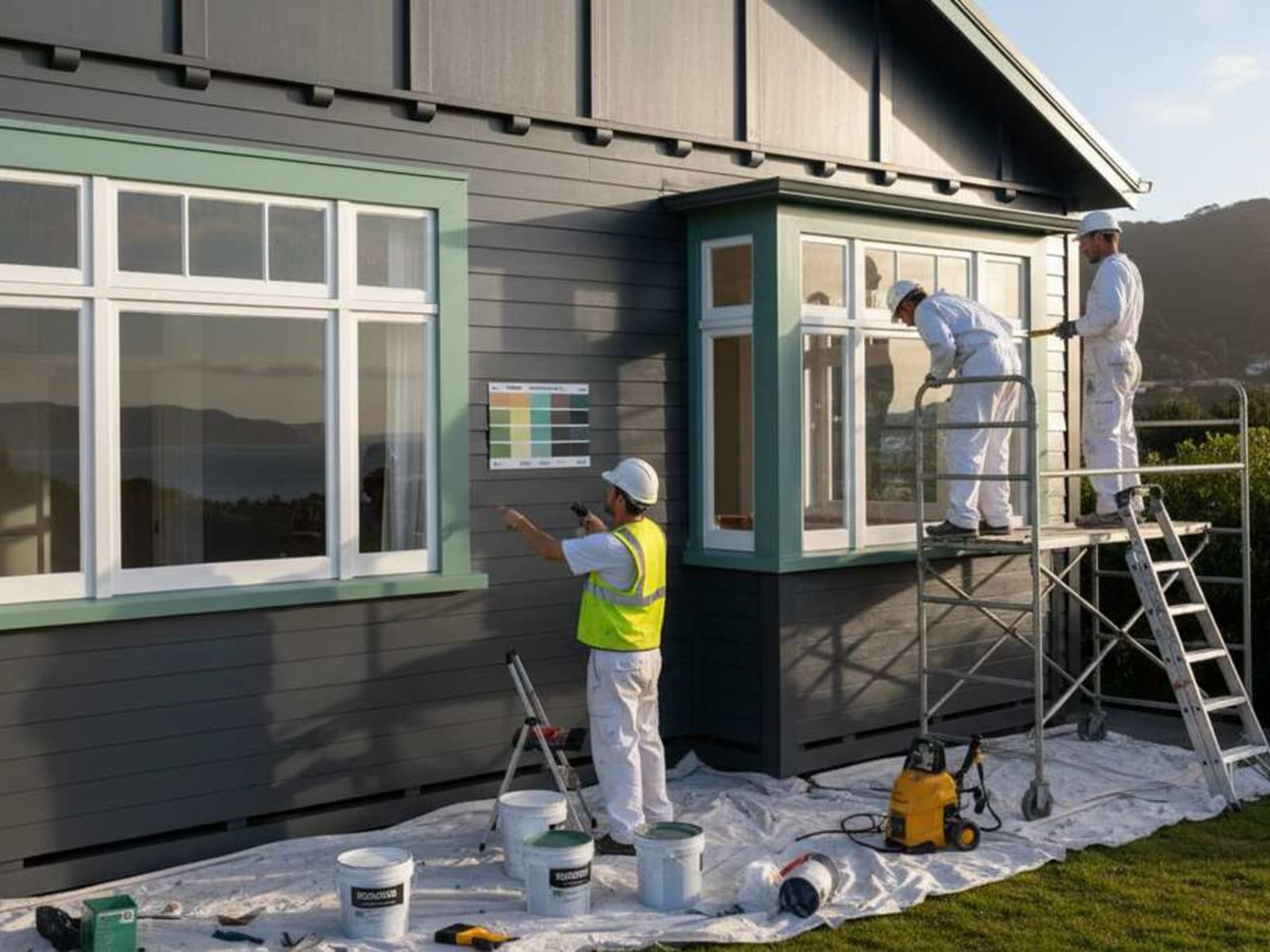
As painters who've coated hundreds of Wellington homes, here are the best Resene exterior colours that perform and look exceptional.
Best Performing Colours for Wellington Weather
Light Colours (Highest Durability)
Resene Alabaster
- One of Resene's most popular whites
- Reflects heat (reduces the expansion/contraction that stresses paint)
- Hides minor dirt and salt deposits
- Shows condition issues early (maintains homes better)
- Timeless, maximizes property value
Resene Half Spanish White
- Warm white alternative
- Slightly more forgiving with dirt than pure white
- Excellent fade resistance
- Suitable for all architectural styles
Resene Rice Cake
- Heritage-appropriate cream
- Warmer appearance than whites
- Excellent durability
- Traditional aesthetic without yellow overtones
Why light colours perform best: They reflect more of the sun's heat rather than absorbing it, reducing thermal stress on the paint film and the substrate. That helps the coating last longer in Wellington's high-UV environment.
Mid-Tones (Good Durability with Character)
Resene Sea Fog
- Soft grey-white that reads lighter than a true mid-tone (Double and Triple Sea Fog add depth)
- Performs well in salt-affected areas
- Modern, sophisticated appearance
- Light enough to show little fading over time
Resene Quarter Stonehenge
- Warm grey-beige that doesn't show dirt
- Excellent choice for low-maintenance appearance
- Suits modern and traditional homes
- Very stable in Wellington conditions
Resene Ironsand
- Charcoal grey for dramatic contemporary look
- Use a premium topcoat (Resene Sonyx 101 or Lumbersider) in a Resene CoolColour version to reduce heat build-up
- More maintenance than lighter colours but achievable
- Increasingly popular for modern renovations
Dark Colours (Higher Maintenance)
Resene Karaka (near-black)
- Statement colour for modern architecture
- Requires highest-quality products, ideally in a Resene CoolColour version
- More frequent maintenance (expect the low end of the 7-10 years Resene quotes for a quality acrylic system, or sooner on exposed faces)
- Heat absorption demands excellent substrate preparation
Our recommendation: Dark exteriors beautiful but commit to proper maintenance. Budget for more frequent repaints.
Heritage Palettes for Wellington Character Homes
Villa Schemes (1880s-1920s)
Classic Wellington Villa:
- Body: Resene Rice Cake or Half Spanish White
- Trim: Resene Alabaster or White
- Feature (doors/windows): Resene Oregon, Claret, or English Holly
Italianate Villa:
- Body: Resene Stonewashed or Eighth Fossil
- Trim: Resene Alabaster
- Feature: Resene Ironsand or Karaka
Bay Villa:
- Body: Resene Barely There or Double Sea Fog
- Trim: Resene Half Alabaster
- Feature: Resene Aubergine or Rivergum
Bungalow Schemes (1920s-1940s)
Californian Bungalow:
- Body: Resene Quarter Stonehenge or Akaroa
- Trim: Resene Half Spanish White
- Feature: Natural timber stain or Resene Oilskin
English Bungalow:
- Body: Resene Rice Cake or Half Spanish White
- Trim: Resene Alabaster
- Roof/Feature: Resene Ironsand

Art Deco (1930s-1940s)
Streamline Moderne:
- Body: Resene Alabaster or Sea Fog
- Feature bands: Resene Ironsand or Rivergum
- Trim: Resene White
Modern Schemes for Contemporary Homes
Minimalist Modern
Monochrome:
- Body: Resene Ironsand
- Trim: Resene White or Alabaster
- Accent: Natural timber or black (Karaka)
Soft Modern:
- Body: Resene Sea Fog or Quarter Stonehenge
- Trim: Resene Alabaster
- Feature: Resene Ironsand
Coastal Contemporary
Weatherboard Modern:
- Body: Resene Alabaster or Half Spanish White
- Feature panels: Resene Sea Fog or natural timber
- Trim: Resene White
Architectural:
- Body: Resene Black White
- Contrast: Resene Karaka or Ironsand
- Accent: Raw concrete or natural materials
Weatherboard Colour Recommendations
Wellington's weatherboard homes (majority of housing stock) suit:
Best performers:
- Resene Alabaster
- Resene Half Spanish White
- Resene Rice Cake
- Resene Sea Fog
- Resene Quarter Stonehenge
Product recommendation: Resene Lumbersider
- Widely used on timber weatherboards
- Flexible (accommodates timber movement)
- Excellent adhesion
- Weather-resistant
Masonry and Concrete Colour Options
Concrete, block, or stucco homes need different approach:
Light colours best:
- Resene Alabaster
- Resene Half Spanish White
- Resene Sea Fog
Product recommendation: Resene Sonyx 101
- Excellent coverage on masonry
- Weather-resistant flexible acrylic film (not an elastomeric membrane)
- Breathable (allows moisture escape)
- Resists Wellington's harsh coastal conditions
Colour Combinations That Maximize Kerb Appeal
High-Value Combinations
Classic High-End:
- Body: Resene Half Spanish White
- Trim: Resene Alabaster
- Door: Resene Oregon or English Holly
- Roof: Charcoal or slate grey
Modern High-End:
- Body: Resene Ironsand
- Trim: Resene White
- Feature: Natural cedar or black
- Roof: Black or dark grey
Heritage Premium:
- Body: Resene Rice Cake
- Trim: Resene Alabaster
- Feature: Resene Claret or Rivergum
- Roof: Terracotta or dark grey
Common Mistakes to Avoid
Too many colours:
More than 3 exterior colours looks busy. Stick to body, trim, feature.
Ignoring roof:
Roof colour must harmonize. Red roof with cool grey walls clashes.
Forgetting fixed elements:
Can't paint: brick chimneys, concrete foundations, stone features. Choose colours that work with these.
Trend-chasing:
Exteriors expensive to repaint. Choose colours with longevity.
Coastal vs Inland Considerations
Coastal Properties (Island Bay, Seatoun, Eastbourne, etc.)
Challenges:
- Salt spray deposits
- High wind exposure
- Moisture penetration
Best colours:
- Light colours (hide salt better)
- Cool tones reference environment
- Resene Sea Fog, Alabaster, Quarter Stonehenge

Product critical: Use Resene Sonyx 101 or Lumbersider with premium preparation.
Inland Properties (Karori, Khandallah, Johnsonville, etc.)
Challenges:
- Less salt but more weather variation
- Bush environment (mould risk)
- Shaded areas retain moisture
Best colours:
- Warm or cool tones both work
- Any colour in recommended palette suitable
Product: Standard Resene Lumbersider or Sonyx 101 suitable.
Roof and Exterior Colour Coordination
Your roof colour influences exterior palette:
Grey/Charcoal roof:
- Works with: Any body colour
- Best matches: Cool tones (Sea Fog, Stonehenge, Alabaster)
Terracotta/Red roof:
- Works with: Warm neutrals, creams
- Best matches: Rice Cake, Half Spanish White, warm greys
Green roof:
- Works with: Neutrals, earth tones
- Best matches: Stonehenge, Akaroa, natural tones
Black roof:
- Works with: Any colour, very versatile
- Best matches: Everything from white to charcoal
Testing Exterior Colours
Exterior colours look dramatically different than interior:
Testing process:
- Purchase Resene 60ml testpots
- Paint large area (1m² minimum) on actual exterior
- Observe for full week minimum
- Check in morning, midday, afternoon, overcast, sunny
- View from street (kerb perspective matters)
- Consider neighbour context
Don't trust: Small colour chips, indoor testing, computer renderings
Trust: Large samples on actual substrate in actual conditions over time.
Professional Preparation Critical
Even best Resene colours fail without proper preparation:
Essential steps:
- Remove failed/flaking paint
- Repair damaged weatherboards/substrate
- Prime bare timber (Resene Quick Dry Primer)
- Two coats topcoat minimum
- Quality products (Lumbersider/Sonyx 101)
Poor preparation is #1 cause of exterior paint failure, regardless of colour chosen.
Longevity Expectations
Light colours (Alabaster, Half Spanish White, Rice Cake):
- 7-10 years between full repaints on exposed Wellington sites (Resene's figure for a quality three-coat acrylic system on weatherboards)
- Often longer on sheltered sites
Mid-tones (Quarter Stonehenge, Stonewashed):
- Similar 7-10 year range, trending lower on exposed faces
- Fading becomes noticeable sooner than on light colours
Dark colours (Ironsand, Karaka):
- Low end of the range, or less, on exposed sites
- Resene CoolColour versions reduce heat stress
These assume professional application with premium Resene products and good maintenance. Resene notes window sills and other slanted surfaces wear faster (around 5-7 years).
How Wellington's Wind Affects Colour Choice
Wellington is one of the windiest cities in the world. Gale-force gusts are a regular reality, not a seasonal event. This affects exterior paint in ways homeowners rarely anticipate.
Wind-driven rain is far more penetrating than vertical rainfall. It forces water sideways into weatherboard joints, around window frames, and under flashings. Paint systems on exposed elevations deteriorate faster than sheltered sides of the same house. Depending on the site, that may be the faces taking the northerlies and afternoon sun, or the south faces hit by southerlies. One side may be pristine while another is already peeling.
What this means for colour choice:
- Dark colours absorb more heat on exposed faces, accelerating thermal cycling and paint stress
- Lighter colours tolerate the movement better and show wind-driven dirt less obviously
- If choosing a dark scheme, budget for touch-ups on the exposed elevation every 4-5 years
- Ask your painter to identify which faces of your home get the most wind exposure before finalising your colour scheme
Neighbourhood Context and Council Rules
Wellington's hillside suburbs have distinctive characters built up over generations. Before committing to a bold colour change, consider two things:
Heritage zones: Suburbs including parts of Thorndon, Mount Victoria, and Aro Valley sit within Wellington City Council heritage protection areas. If your home is a listed heritage building or in a scheduled area, check with the council before changing its colours. Resene's heritage colour range is a useful starting point for period-appropriate schemes.
Neighbourhood fit: This isn't about conformity — it's about property value. A bright orange house in a street of weathered neutrals will be harder to sell. Your exterior colour is a long-term investment that needs to work with, not against, the surrounding context.
Practical check: Walk your street at different times of day before finalising. Look at what colours your neighbours have used, what roof colours are common, and what the general character is. Then position your home within that context with your own identity.
Frequently Asked Questions
How much does an exterior repaint cost in Wellington?
As a 2026 guide, a typical three-bedroom home (around 150 m² floor area) runs about $9,000-$13,500+, and most exterior repaints fall between $6,000 and $20,000+ depending on size, condition, access difficulty, and paint system. Homes with significant weatherboard rot, peeling paint, or complex rooflines cost more. Get a site-specific quote — online estimates are rarely accurate for Wellington's varied housing stock.
How long should I wait between exterior repaints?
Resene expects a quality three-coat acrylic system on timber weatherboards to perform for 7-10 years, with sills and other slanted surfaces wearing sooner. If your paint is failing well before that, it often indicates poor preparation or budget products were used. Quality work lasts significantly longer.
Can I paint my exterior in winter?
Yes, but with conditions. Wellington winters are mild enough for exterior painting but require dry spells of at least 48 hours. Experienced painters monitor weather windows carefully. We typically schedule exterior work from October through April where possible, but can work year-round on sheltered elevations.
Is it worth spending more on premium Resene products?
Always. The difference between budget and premium products over a 10-year lifespan is significant. Budget paint on a Wellington exterior may need repainting noticeably sooner. A quality acrylic system typically lasts 7-10 years on weatherboards. The labour cost of repainting is far larger than the material cost — investing in better paint extends the interval between jobs and saves money long-term.
Do I need to tell my insurer when repainting?
Generally no for cosmetic repaints. However, if your painter identifies weathertightness issues — rot, failed cladding joints, or moisture ingress — document these and notify your insurer. Unresolved weathertightness problems affect your cover.
Related Services:
- Exterior House Painting — Professional weather-resistant exterior coating
- Weatherboard Painting — Specialist timber exterior painting
- Resene Eco Decorator — Certified Resene application
Planning exterior repainting? Contact us for site-specific colour recommendations and free quote. We'll help you choose colours that look great and last.

Professional Colour Consultation in Your Area
Need help choosing the right colours? We offer free colour consultations across Wellington: Paint Colour Visualiser · Paint Cost Calculator · Exterior Painting · Interior Painting. Get a free quote today.
Related Articles


Need Help With Your Painting Project?
Wellington Decorators has been transforming homes across the Wellington region since 2023, led by a founder with 18+ years in the trade. As Registered Master Painters, we back every job with a 5-year workmanship guarantee.
Prefer to talk? Call us now 027 458 6465