
Sealant belongs where the cladding meets something else: window and door joinery, corner boxing and scribers, and penetrations such as taps, pipes and meter boxes. It does not belong in the horizontal laps between weatherboards, along the bottom edge of a board, or at the base of the cladding, because those gaps are how water that gets in gets back out.
A weatherboard lap is not meant to be a sealed joint. Timber weatherboards move, and that movement can let occasional water through the lap, but the same gap is what lets air circulate and lets the water drain back out. Seal it and you keep the water in.
Why does a wall need gaps at all?
A timber-clad wall is not built to be watertight. It is built to shed most of the water, allow a small amount through in bad weather, then drain and dry. Every stage of that has to keep working. Close the drainage path and an occasional wetting that used to dry out in a day sits against the back of the board instead.
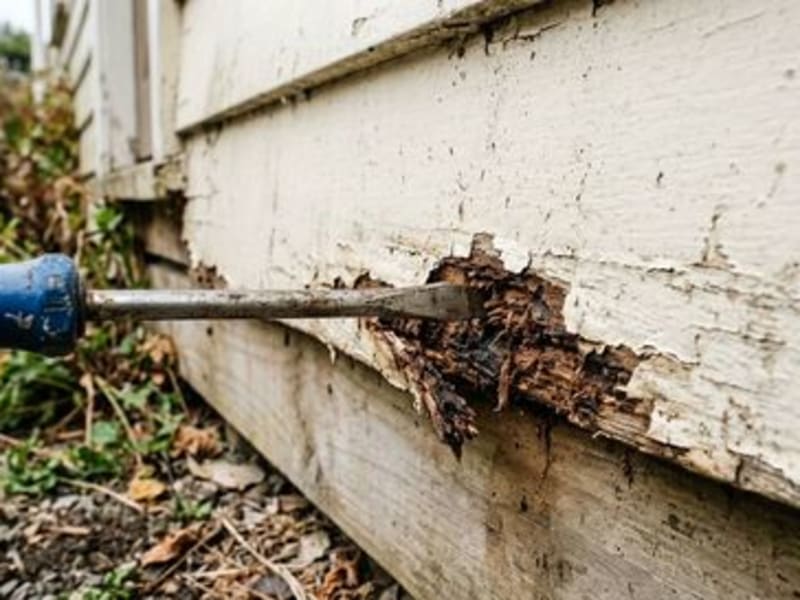
The failure that follows is slow and quiet. The face still looks painted, sometimes for years, while the back of the board and the framing behind it stay damp. By the time paint blisters on the outside you are usually looking at soft timber underneath.

Where does sealant genuinely help?
| Location | Seal it? | Why |
|---|---|---|
| Cladding to window and door joinery | Yes | A designed joint. Use backing rod and a flexible exterior sealant, over a flashing, never instead of one. |
| Scribers, corner boxing and vertical junctions | Yes, a neat bead | Stops wind-driven water at a junction with no other defence. |
| Around pipes, taps, vents and meter boxes | Yes | Penetrations are a known weak point and there is no drainage path to block. |
| Butt joints in a board run | Only over solid framing | Prime the end grain first. Sealant is not a substitute for primed end grain. |
| Nail holes and small dents | No, use exterior filler | Sealant stays soft, telegraphs through the paint and collects dirt. |
| Horizontal laps between boards | No | This is the drainage and drying path. |
| Bottom edge of any board | No | Water runs off a free edge. Sealed, it wicks back in. |
| Base of the cladding at the bottom of the wall | No | The bottom of the wall is the exit. Blocking it is the worst version of this mistake. |
| The gap under a window head flashing | No | That gap drains the flashing. Sealing it sends water into the wall above the window. |
| Where cladding meets a path or the ground | No, sort out the clearance | Cladding needs clearance from the ground, not a sealed joint with it. |

What actually goes wrong when the laps are sealed?
Water gets into a weatherboard wall from above, not from the lap: a nail hole, an unprimed end grain joint, a gap at a scriber, a tired head flashing. It then runs down the back of the boards and out at the laps and the base of the wall. Bead the laps and it has nowhere to go, so it sits in the lap and the timber takes it up.
Wellington makes this worse in a particular way. Wind-driven rain does not fall, it travels sideways and sometimes upward, so water is pushed into laps on the south and west that would never wet in still conditions. Those are the same walls that dry slowest through winter. A sealed lap on a south-facing wall is the most reliable way to rot a board that would otherwise have lasted decades.
Which sealant, and applied how?
For movement joints, a paintable exterior grade sealant, typically a low-modulus polyurethane or an MS polymer. Never use silicone anywhere you intend to paint, because paint will not stick to it and you cannot get it off the timber afterwards.
Two application points matter more than the brand on the tube. Use backing rod in any joint with real width, so the sealant bonds to two faces and can stretch, rather than to three faces where it tears itself apart on the first cold night. And do not tool it out to a feather edge, because that thin edge is the first part to fail and it looks worse in a year than a clean, slightly proud bead.

Should you do any of this before the painters arrive?
Sealing an obvious gap around a meter box or a tap penetration is reasonable homeowner maintenance. Anything involving joinery junctions, head flashings or the base of the cladding is not, because the right answer there is often a flashing rather than a bead, and a bead applied over a flashing problem hides it for a couple of years.
The most common homeowner mistake is running sealant along every lap on the wall because it looks tidier and feels like it must be helping. That is the one place where it does the most damage.
What if someone has already sealed the laps?
It can be removed. Cut along both edges with a sharp blade, rake it out, and take care not to gouge the timber, because a scored board is a new problem rather than a fix. Whether the labour is worth it depends on what is behind it. If the boards sound solid, the paint film is intact and there is no staining inside, taking it out during the next repaint is cheap insurance while access is already there and paid for.
If boards feel soft, if paint is lifting in patches near the laps, or if there is staining on the inside face of that wall, stop and get moisture readings before anybody paints anything. Repainting over trapped moisture wastes the entire job, because the new film fails in the same places within a season or two.

What should preparation on a repaint include?
Ask for the junctions to be inspected as a named part of the preparation, not just washed and coated. That means checking head flashings, scriber junctions, end grain at butt joints and the bottom of the cladding, removing sealant that is doing harm, and replacing sealant that has hardened and split at the joinery.
It adds hours to the preparation stage of an exterior repaint, and it is the difference between a paint job that lasts and one that looks good for two summers. A quote that says "wash, prep, two coats" and nothing else is not telling you whether any of this is happening.
If you are unsure what has been sealed on your house or whether it matters, ask us to take a look before you book anyone to repaint it.
Related Articles


Need Help With Your Painting Project?
Wellington Decorators has been transforming homes across the Wellington region since 2023, led by a founder with 18+ years in the trade. As Registered Master Painters, we back every job with a 5-year workmanship guarantee.
Prefer to talk? Call us now 027 458 6465