
A grey that looked neutral on the chart turns blue or green in a south-facing room because the room gets no direct sun, only cool light from the sky, and that light pulls out whatever cool undertone the grey already had. The paint has not changed; the light has, and grey is the colour most easily pushed around by it.
The fix is not a different brand. It is choosing a grey with a warmer undertone, or a deeper version of the one you like, and testing it on the wall that actually faces south before you buy litres of it.
Why does grey change more than other colours?
Most greys are not pure black and white mixed together. They carry a small amount of another hue, which is their undertone: a little blue, green, violet, yellow or brown. On a strong colour like red, a slight shift in light barely registers. On a grey, the undertone is almost the only colour there is, so any light that favours it makes it stand out.
Resene's own guidance on room orientation says that in south-facing rooms the natural light is cool, grey or sour, and that no amount of pale tints or white will make these rooms appealing. Put a cool grey into that light and the light reinforces the coolness. A grey with a hint of blue reads as blue. A grey with a hint of green reads as green or khaki.
Two other things in a Wellington house push it further. Resene notes that where natural light is filtered through trees growing close to the house, a green cast can appear in any colour you use, and plenty of south-facing rooms on steep sections look straight into bush or a bank. And at night, Resene says a warm incandescent-style light will make yellow or cream walls glow but turn blue and lavender walls grey, so the same wall can look like two different colours morning and evening.

How can you tell a grey's undertone before you buy it?
Resene's colour codes help. According to Resene, the first letter of the code tells you what type of colour it is, and the last three numbers show where it sits on the colour wheel, with red at 0 (its red group runs from 357 round to 39), yellow from 70 to 90, green from 91 to 204 and blue from 205 to 284. N means neutral, a very low saturation colour. So two greys that look alike on a small chip can have codes that tell you one leans yellow and the other leans toward green or blue.
The other simple trick, also from Resene, is to put a piece of white printer paper between the swatches you are comparing. Against pure white, undertones that are invisible on their own become obvious.
A rough guide to how the families behave in cool, indirect light:
| Grey family | Resene examples | How it tends to read in a south-facing room |
|---|---|---|
| Storm greys with blue or green undertones | Bounty, Emerge | Leans harder into blue or green; can feel cold |
| Grey-edged whites | Sea Fog, Black White, Alabaster | Stays pale, but can look flat or slightly cool in shadow |
| Warm smoky greys with a hint of brown | Eighth Masala | Holds its warmth; the undertone offsets the cool light |
| Warm charcoals | Half Nocturnal | Deep and enclosing; suits a room you want to feel cosy |
The groupings are Resene's own: its Habitat articles describe Bounty and Emerge as storm greys with blue or green undertones, list Sea Fog, Black White and Alabaster among its grey whites, and suggest Eighth Masala and Half Nocturnal for south-facing living rooms that need warmth.
Which grey should you pick for a low-light room?
Go warmer and go a little deeper than your instinct says.
- Warm the undertone. Look for greys with a brown, beige or yellow base rather than blue or green. Resene's colour-by-compass advice for south-facing rooms is warm mid-toned colours.
- Do not go paler to fix it. A pale cool grey in a dim room just looks grubby. Resene says south and north-facing rooms usually work better with deeper versions of a colour, while east and west rooms suit the lighter variants.
- Use strength variations. If you want one grey through the whole house, use the full-strength or double version in the south (and north) rooms and the half or quarter in east and west rooms, rather than switching colour.
- Consider a warm neutral instead. If what you want is a calm, light room rather than grey specifically, a warm off-white or soft beige may simply suit the light better.
If you are drawn to a grey-edged white like Sea Fog for a darker room, our guide to Resene Sea Fog and its strengths covers how its half, quarter and double versions differ.

How should you sample it so the surprise happens before you paint?
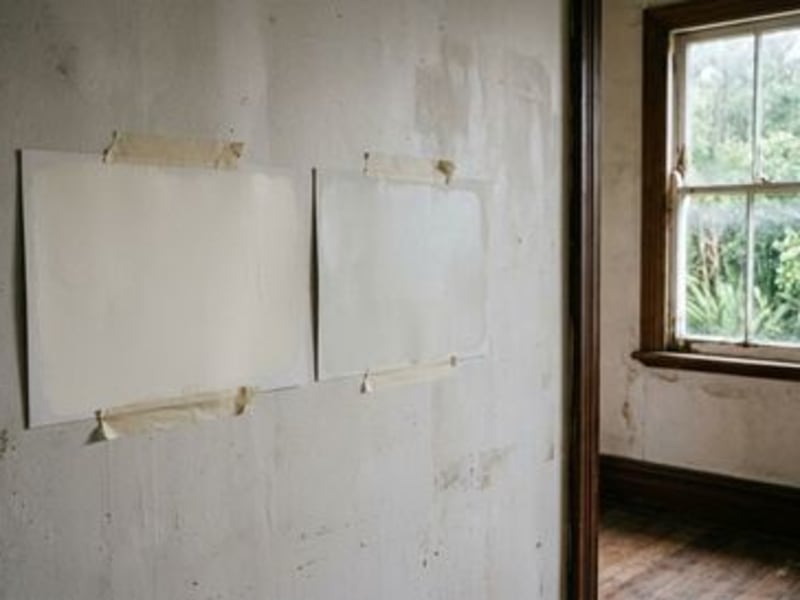
Paint the sample big and put it where it will live. Resene's advice is to paint your testpot colour onto a piece of A2 card, leaving an unpainted border so your eye sees the colour rather than the edge, then move the card from wall to wall and room to room.
For a south-facing room in particular:
- Paint two coats on the card, not one. One coat of a pale grey looks different from the finished wall.
- Look at it on the wall opposite the window and on the window wall itself, which will be in its own shadow.
- Check it in the morning, mid-afternoon and at night with your own light bulbs on.
- Look at it next to your floor, curtains and furniture, not on its own. Resene notes that a room's furnishings and accessories can push an off-white toward their colour.
- Compare two or three candidates side by side. The one that looks slightly too warm on the chart is often right in the room.
This costs a few testpots and a couple of days. Repainting a room because the grey turned out blue costs a great deal more. If you are trying to match a grey you already have on the walls elsewhere, matching paint to an existing wall explains the pitfalls.

Is it ever the paint rather than the light?
Occasionally. A wrong tint at the shop, or a different sheen from the sample, can make a finished wall look off. Check the colour name and code on the tin lid against what you chose. But when the grey looks right in one room and blue in the south-facing one, the paint is the same and the light is doing it.
If you want help choosing and testing colours for a darker room before committing to a full repaint, contact us for a free quote.
Related Articles

Need Help With Your Painting Project?
Wellington Decorators has been transforming homes across the Wellington region since 2023, led by a founder with 18+ years in the trade. As Registered Master Painters, we back every job with a 5-year workmanship guarantee.
Prefer to talk? Call us now 027 458 6465