
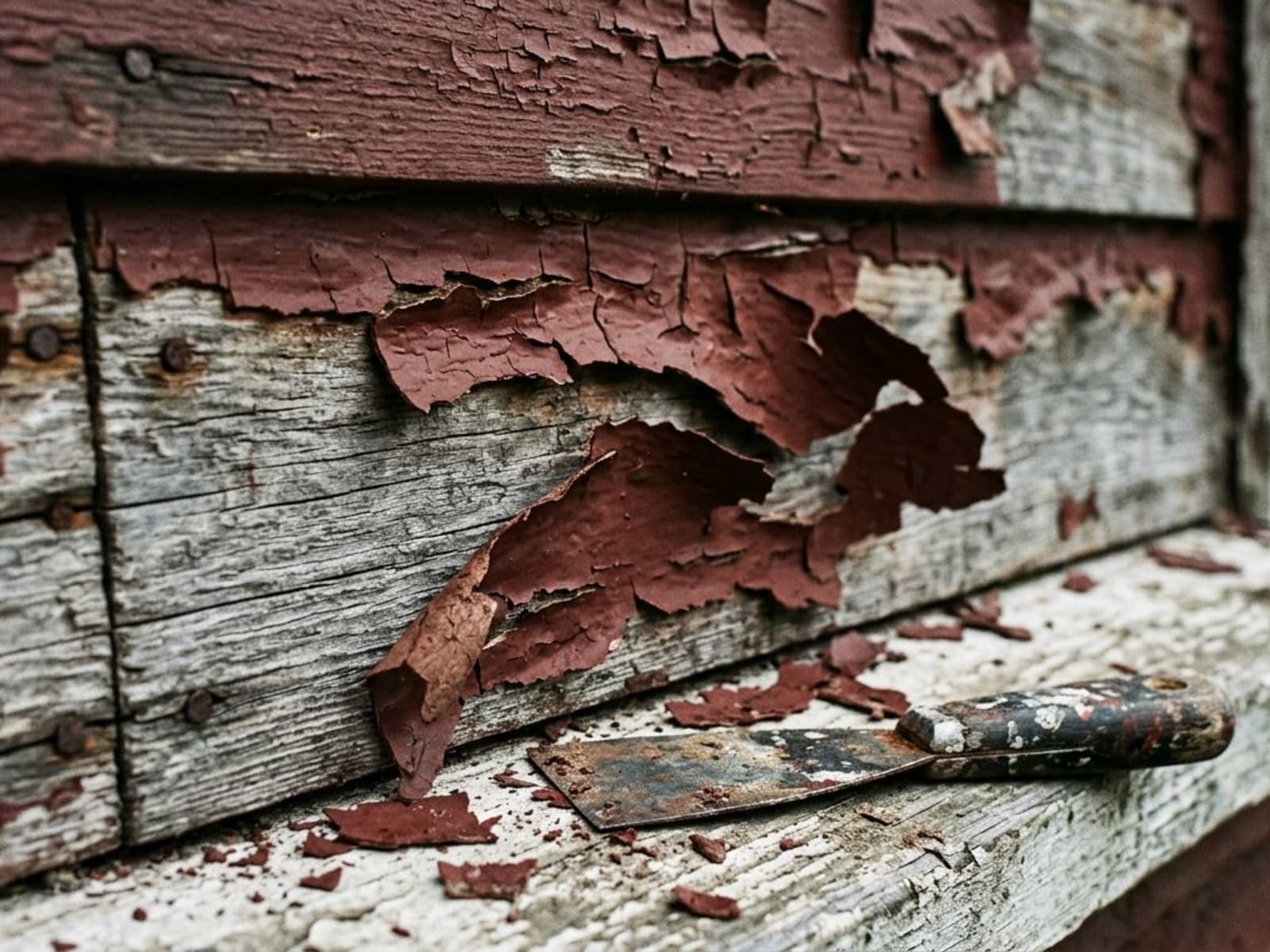
In our experience, paint goes over old stain well if that stain is a penetrating type that has weathered away into the timber, and the boards are cleaned and primed with a primer that suits the timber. A surface-forming stain, the kind that sits on top of the wood like a thin paint and peels in flakes, has to be stripped first, because anything painted over it is only as well stuck as that old film.
So the first job is not choosing a colour. It is working out which kind of stain you have.
Which kind of stain is on your weatherboards?
Penetrating stains soak into the timber and wear away by fading. Surface-forming stains build a film and fail by cracking and peeling. Resene's woodcare guide says that if a stain is peeling or flaking, it is likely to be a surface-forming stain and will probably need to be removed before a penetrating stain goes on. Our view is simple: if it has to come off before restaining, it has to come off before painting too.
| What you see | Weathered penetrating stain | Surface-forming (film) stain |
|---|---|---|
| How it has aged | Faded and patchy, worst on sunny walls, no loose edges | Cracking, lifting and flaking, often in sheets on exposed walls |
| Grain | Clearly visible, colour is in the wood | Grain partly hidden, colour sits on top |
| Sheen | Flat, dry-looking | Often a slight sheen where it is intact |
| Splash of water | Soaks in and darkens the timber | Beads up on the intact parts |
| Tape test (press tape on, rip it off) | Little or nothing comes away | Flakes of coating come off on the tape |
The splash test comes from Resene's deck staining instructions, where water beading on old stain means the coating needs to be stripped or sanded back, or left to weather further, before a new stain will go in. We use the same check before painting. In our experience, if water cannot get into the surface, primer struggles to grip it too.

Can you paint straight over a weathered penetrating stain?
Not straight over, but close to it. In our experience, a penetrating stain that has faded to the point where water soaks into the timber leaves a surface that can be primed and painted once it is properly prepared. This is our own practice rather than a manufacturer instruction: the Resene guidance we refer to covers restaining, and painting bare or aged cedar, not painting over old stain as such. So tell your paint supplier what stain is on the boards and ask them to confirm the system. Our usual sequence:
- Kill any mould, moss and lichen with a moss and mould killer.
- Scrub the boards with a timber and deck wash and a stiff brush, then rinse well. Resene advises against waterblasting cedar in particular, because it is soft enough to gouge.
- Let the timber dry thoroughly.
- Sand any furred or rough areas where practical. Rough-sawn boards are hard to sand, which is where a timber conditioner earns its place (more on that below).
- Prime every board, not just the bare patches.
- Two topcoats of exterior paint.
If water still beads on your boards, the stain has more life in it than you think. Either give it more time to weather, or sand the surface back until water soaks in. Painting over stain that is still repelling water is one of the more common reasons we see new paint peel early.
Do you have to strip a surface-forming stain?
In practice, yes. Resene's guidance for cedar is to avoid painting over surface-forming wood stains unless they are stripped, because the top layer of cedar degrades quickly under UV and the stain flakes off, taking anything on top of it with it. The same logic applies to any timber: new paint cannot hold on better than the coating underneath.
Stripping is slow, and this is where the cost of the switch sits. Heat and chemical stripping both work on weatherboards; which suits depends on the timber and the building. If the house was built before the 1980s, some boards or trim may carry lead-based paint under or near the stain, so have it tested before any sanding or stripping starts.
Which primer goes over old stain?
This is the question that decides whether the job lasts, and the answer depends on the timber more than the stain.
- Cedar and redwood. These contain water-soluble tannins that bleed through waterborne primers and paints, including Resene's own waterborne Quick Dry primer. Resene's recommendation for cedar is its solventborne Wood Primer, both for new cedar and for spot priming on repaints. Our article on tannin stains on painted cedar shows what happens when that step is skipped.
- Aged, grey cedar. Resene says it can be painted, but should first be conditioned with its TimberLock product before priming, particularly where the boards are rough-sawn and cannot realistically be sanded.
- Pine and most other timbers. A good exterior timber primer suits most, but check with the paint supplier and tell them what stain was on the boards. Resene's exterior timber notes describe its solventborne Wood Primer as excellent for old timber, especially timber that is weathered and grey, and say it holds back most water-soluble stains such as tannin and salt bleed.
Whatever brand you use, stay inside one manufacturer's system from primer to topcoat. Their data sheets are written around their own products.
Is switching from stain to paint worth it?
Often, yes. The main reasons people switch:
- They want a lighter colour. Resene notes that you cannot lighten a stain unless you remove the previous coating or paint. If you are tired of dark brown, paint is the realistic route.
- The stain has become patchy and each restain darkens the house further to hide it.
- They want simpler upkeep. Resene describes cedar as an excellent substrate for paint that is easy to repaint once painted.
The trade-off is that it is a one-way door. Once weatherboards are painted, going back to a stained look means stripping every board. And if you pick a dark paint colour, ask about heat-reflective versions: Resene's weatherboard painting guide suggests light colours or its CoolColour formulas to reduce heat absorption.
On price, the switch is essentially an exterior repaint with heavier preparation. Our published exterior range is $6,000 to $20,000 or more as at 2026, and the stripping or conditioning work described above is what pushes a stained house towards the upper part of that band. Our exterior painting quotes list the preparation separately so you can see it.

When should you just restain instead?
If you like the stained look, the stain is a penetrating type in fair condition, and the timber is sound, restaining is cheaper and quicker than converting to paint. Clean it, kill the mould, and apply more of the same or a darker shade. Our wood staining service covers that route, and we will tell you which one your house actually needs.
Not sure what is on your walls? Ask us to take a look before you buy primer.
Related Articles


Need Help With Your Painting Project?
Wellington Decorators has been transforming homes across the Wellington region since 2023, led by a founder with 18+ years in the trade. As Registered Master Painters, we back every job with a 5-year workmanship guarantee.
Prefer to talk? Call us now 027 458 6465